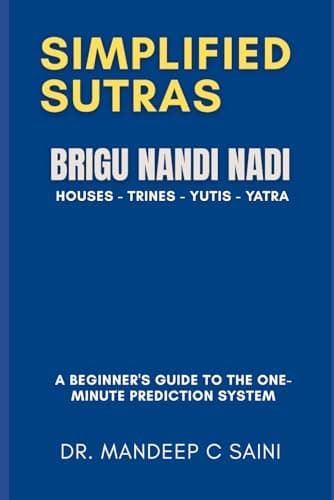
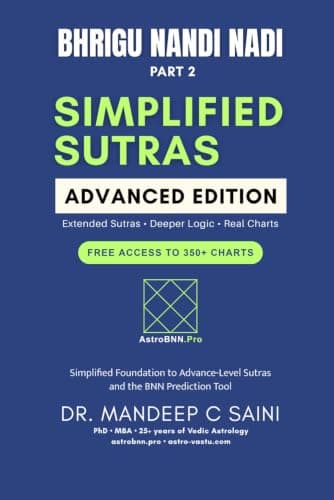
Four circuits, not twelve rooms
The idea readers coming from other systems find hardest is that a trine is not three separate houses. It is one circuit that behaves as a unit, so a planet in the 2nd and a planet in the 10th act as though they were sitting together, however far apart they look on the page.
Get that, and a chart stops being a list of placements and starts being four systems doing four jobs:
- Dharma, houses 1, 5 and 9: self, creativity, fortune. What a person is for.
- Artha, houses 2, 6 and 10: wealth, work, profession. Resources and effort.
- Kama, houses 3, 7 and 11: desire, partnership, gains. What is wanted, and with whom.
- Moksha, houses 4, 8 and 12: home, change, release. The private half of a life.
Taught through charts you can check
The book works through the charts of people whose lives are already a matter of public record, among them Dr. APJ Abdul Kalam, Mahatma Gandhi, Dhirubhai Ambani and Amitabh Bachchan, each chosen because one trine dominates the life clearly.
This is a deliberate teaching decision. A method demonstrated on a life nobody can verify asks you to trust the author. A method traced through a life already on the record lets you check whether the chain actually produced what it is claimed to have produced. That is the same argument the rest of the series makes about auditability.
Where it stands
In drafting. It sits between the first Simplified Sutras book and the advanced edition: read it once the planetary chains make sense, and before the advanced sutras.
The trines themselves are set out at BNN astrology, and applied to a chart in a consultation.